
Understanding Sound Sensitivity: Practical Ways to Find Calm and Focus
A sound that barely registers for one person can feel unbearable to another. Chewing, tapping, sniffing, a pen clicking, cutlery scraping a plate, polystyrene squeaking, loud breathing, or snoring can trigger a rush of irritation, panic, disgust, anger, or the urgent need to escape.
This is not “being dramatic”. For many people, sound sensitivity is a real nervous system response. The body reacts before the thinking mind has time to reason with it.
The good news is that there are practical ways to reduce the strain. The aim is not to force yourself to tolerate everything. It is to understand what is happening, protect your wellbeing, and build a set of tools that helps you feel steadier in noisy moments.
This article is for information only and is not a substitute for medical or mental health advice. If sound sensitivity is affecting daily life, relationships, sleep, or work, it can be helpful to speak with a GP, therapist, audiologist, or occupational therapist.

What sound sensitivity can feel like
Sound sensitivity can show up in different ways. Some people feel overwhelmed by loud or unpredictable noise, such as alarms, traffic, barking dogs, or children shouting. Others react strongly to specific everyday sounds, even when they are quiet.
A common example is misophonia, a condition where particular trigger sounds cause a strong emotional or physical reaction. These triggers often include eating noises, breathing, throat clearing, tapping, clicking, keyboard noise, or repeated rustling. The sound itself may not be loud, but the reaction can be intense.
Other forms of sound sensitivity include:
Hyperacusis Everyday sounds feel painfully loud or sharp.
Sensory overload Too much noise, light, movement, or social input builds up until the brain feels flooded.
Auditory defensiveness Certain sounds feel threatening or intolerable, often linked with sensory processing differences.
The reaction can include clenched muscles, racing thoughts, anger, nausea, anxiety, shame, or a sense of being trapped. Some people freeze. Others snap at the person making the noise, then feel guilty afterwards.
This is one reason sound sensitivity can affect relationships. A partner eating crisps, a colleague tapping their foot, or a neighbour’s late-night noisiness may become more than a passing irritation. It can feel personal, even when it is not.
The first step is to separate the trigger from the person. The sound is causing a nervous system response. The person may simply be breathing, eating, or moving through their day. That distinction can create space for calmer choices.
Why certain sounds can feel so intense
Sound sensitivity is rarely about sound alone. It often involves the relationship between hearing, attention, emotion, memory, and the body’s threat response.
The brain constantly filters sensory information. It decides what to ignore, what to notice, and what might be important. When that filtering system is under strain, ordinary sounds can feel impossible to tune out.
Trauma can make the nervous system more watchful
After trauma or long periods of stress, the body can become highly alert to possible danger. This is sometimes called hypervigilance. The brain scans for signals that something is wrong, even in safe places.
For some people, a sound becomes linked with a difficult memory or a period when they felt powerless. A door slam, raised voice, footsteps, or a particular eating sound may not seem serious from the outside. Inside the body, it may activate an old alarm system.
This does not mean every sound trigger comes from trauma. It means trauma can lower the threshold for overwhelm. When the body already feels unsafe, noise has less distance to travel before it becomes unbearable.
Autism can involve stronger sensory processing
Many autistic people experience sensory input more intensely. Sounds may feel sharper, louder, more layered, or harder to filter. Background noise can compete with speech. Repetitive sounds may become painfully intrusive.
This can make ordinary environments tiring. A café might include music, coffee machines, cutlery, chairs scraping, several conversations, traffic outside, and lights buzzing. For someone with sensory sensitivity, these do not blend into the background. They arrive all at once.
Sound sensitivity in autism is not a flaw. It is part of a different sensory profile. Support often starts with reducing unnecessary input rather than expecting the person to “get over it”.
ADHD can make sounds harder to ignore
ADHD can affect attention regulation. That means the issue is not always a lack of attention. It can be difficulty choosing where attention goes and keeping it there.
A small sound might pull attention away again and again. Once noticed, it can become almost impossible to unhear. This can be especially draining during reading, studying, conversations, or tasks that need sustained effort.
Some people with ADHD also seek sensory stimulation at some times and feel overloaded at others. The same person who enjoys loud music may struggle with repetitive chewing or a ticking clock. Context matters.

Create an environment that supports your nervous system
A calmer environment will not remove every trigger, but it can reduce the number of times your body has to brace itself. Think of this as lowering the background load.
Use noise-cancelling headphones with care
I was first diagnosed with ADHD in 2022, just as my company started to encourage people back into the office after Covid. I was really lucky that when I explained how hard it was for me to return to the office, they bought me a pair of noise-cancelling headphones. The difference was remarkable. Suddenly, I was able to focus again and using calming music to regulate my nervous system in the often loud, open-plan office.
When my role changed and I started to attend massive amounts of meetings when I was in the office, I started to struggle, so then I began to block time between meetings where I could complete tasks and using the headphones to regulate myself between meetings and this helped me so much. I've used them while travelling. I've used while I do housework so that I can concentrate and maintain my motivation. I've used them when my kids are just being kids but I need 15 minutes to focus.
They work best as part of a wider toolkit. Wearing them all day may make some people feel more sensitive when they take them off. Others find regular use essential. Notice how your body responds.
You might try:
Over-ear noise-cancelling headphones for low background hum
Earplugs for short, specific situations
Loop-style ear filters that reduce volume without blocking all sound
One earbud only, if full blocking feels unsafe
Some people need to hear enough to feel aware of their surroundings. Others need strong reduction to calm down. There is no single correct choice.
Add steady sound rather than complete silence
Silence can be soothing, but it can also make small sounds stand out more. A steady background sound may soften sudden or repetitive triggers.
Options include:
White noise
Brown noise
Rain sounds
Gentle instrumental music
A fan
Nature recordings
Low-volume calming music
A soundbath recording or soft ambient track may help some people relax, while others find layered tones too stimulating. Experiment with volume, rhythm, and texture. The best background sound is one your brain can stop tracking.
Try using the same calming audio during rest or study. Over time, your body may start to associate it with settling.
Use the trigger as a doorway back to the breath
When a trigger sound appears, the first instinct may be to fight it, judge it, or escape it. Sometimes leaving is the right choice. At other times, especially when escape is not possible, the experience can become a practice in returning to the body.
This does not mean pretending the sound is pleasant. It means building a little more choice inside the reaction.
The breath is useful because it is always present. It gives attention somewhere steady to land.
Try this simple practice:
Notice the first signal
This might be a tightening jaw, heat in the chest, irritation, or the thought “I cannot stand this”.
Name the experience quietly
Use a simple phrase such as “sound trigger” or “my body is reacting”.
Lower the shoulders
This sends a small message of safety to the body.
Lengthen the out-breath
Breathe in gently, then breathe out a little longer than usual. Do not force a deep breath.
Choose one anchor
Feel both feet on the floor, the contact of your hands, or the movement of air at the nostrils.
Set your boundaries
Allow the sound to exist but notice your boundaries. Notice the silence within you. You can be on a mountaintop but have a head full of noise. Or you can be in a crowded room with silence and space in your heart. Visualise your breath to focus on the space and silence within you.
This kind of mindfulness is not about becoming perfectly calm. It is about reducing the spiral. A trigger may still be there, but you may gain one extra second before reacting. That second matters.
With practice, you can train your focus to become more flexible. The sound may pull attention, then the breath invites it back. This is a skill, and skills grow through repetition.

Set boundaries without shame
Sound sensitivity often becomes harder when people feel they must hide it. Shame adds another layer of stress. Clear, kind boundaries can protect relationships as well as wellbeing.
A good boundary is specific and realistic. It explains what helps without blaming the other person.
For example:
“I’m finding chewing sounds difficult today. I’m going to sit in the other room while we eat, then come back after.”
“Could we keep the TV volume lower after 9 pm?”
“I can concentrate better when there is less tapping. Would you mind using a coaster or soft mat?”
“If I put my headphones on, I’m not ignoring you. I’m helping myself stay regulated.”
Some situations need negotiation. Shared homes, workplaces, trains, restaurants, and family meals all involve other people’s needs too. Aim for practical agreements rather than perfect control.
It can also help to create a plan before a difficult situation. If you know a meal, journey, or visit may include trigger sounds, decide in advance:
Where you can take a break
What ear protection you can bring
How you will explain your needs
What signal you can use if you need to leave briefly
How long you realistically want to stay
Planning reduces the feeling of being trapped. Even knowing there is an exit can calm the body.
Experiment until you find your own mix
There is no universal method for sound sensitivity. One person may need silence. Another may need background audio. One person finds meditation grounding. Another feels more settled through walking, stretching, or doing something with their hands.
Use gentle trial and error. Treat each method as an experiment, not a test of willpower.
Track patterns without obsessing
A short note can reveal useful patterns. You might record:
The trigger sound
Where you were
How tired, hungry, or stressed you felt
What helped
How long it took to settle
Many people find sensitivity rises when they are exhausted, overstimulated, anxious, hormonal, unwell, or under pressure. If that is true for you, prevention may involve rest, food, breaks, and fewer sensory demands.
Build a small sound sensitivity kit
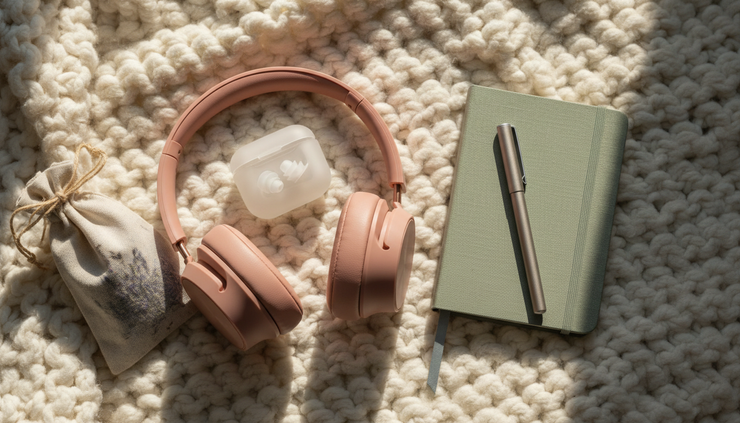
Keep a few supports in a bag, drawer, or bedside table. Possible items include:
Earplugs
Noise-cancelling headphones
A calming playlist
Chewing gum or mints
A grounding object
Sunglasses or a cap if light adds to overload
A note that reminds you what to do when triggered
A smell like a perfume or rollerball that you associate with feeling calm.
A written reminder helps because the thinking brain can go offline when the body feels threatened. Simple phrases work best, such as “breathe out”, “feet on floor”, or “step away for two minutes”.
Know when to seek extra support
Self-help strategies can be powerful, but they are not always enough. Professional support may be useful if sound sensitivity causes panic, rage, avoidance, sleep loss, conflict, or isolation.
Depending on the situation, support may include:
A hearing assessment
Occupational therapy for sensory needs
Therapy for trauma or anxiety
ADHD or autism assessment
Practical adjustments at work or in education
The right support should not shame you for your reactions. It should help you understand them and build a more manageable life.
Finding calm is a practice, not a personality trait
Sound sensitivity can be exhausting, especially when the trigger seems ordinary to everyone else. It can make daily life feel unpredictable. It can also bring up guilt, frustration, and the fear of being misunderstood.
Start with compassion. Your reaction is information from your nervous system. It is not a character flaw.
From there, build a practical toolkit. Create quieter spaces where you can. Use headphones or earplugs when they help. Add steady background audio if silence makes triggers sharper. Set kind boundaries. Practise returning to the breath, one out-breath at a time.
Most of all, experiment. Notice what works in real life, not what “should” work. A useful strategy is one that helps your body feel safer, your attention feel steadier, and your day feel a little more possible.
Finding calm in a soundbath
It might not be the messon you signed up for when you booked but if you struggle to let go of a disruptive sound in a soundbath, this could be the lesson that you need most right now.
I hope this helps.
You've got this!



Comments